At a Glance
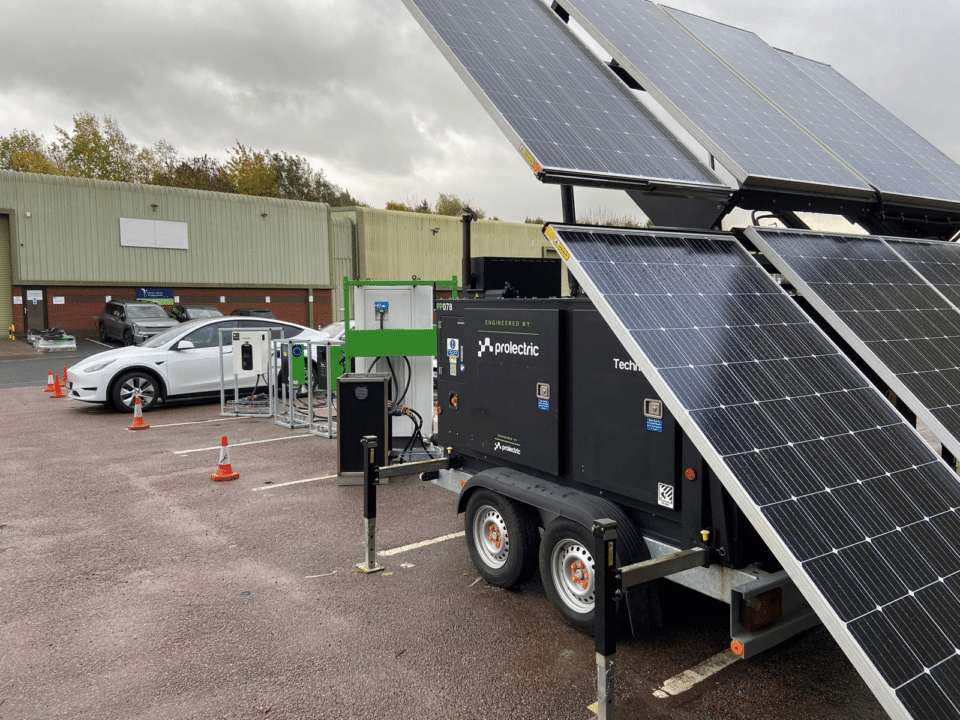
Off-grid and grid-assisted charging systems combine solar generation, battery storage and controlled backup power to provide energy where the grid is unavailable or constrained. By prioritising solar and stored energy, they can reduce continuous generator operation while maintaining the resilience required to keep priority vehicles and plant available.
Off-Grid Charging Series | Part 2 of 3
Part two examines how off-grid and grid-assisted power can support temporary EV charging, why resilience matters and how solar hybrid and battery systems can reduce reliance on continuously running generators.
The Case for Resilient, Off-Grid EV Charging
Reliable charging is not only an energy issue. It is an operational requirement.
If the available power supply fails or cannot meet demand, charging stops. Vehicles and plant may then be unavailable for the next shift, delaying planned work and increasing labour, hire and programme costs. The consequences are especially significant when the affected equipment supports critical operations or cannot be replaced quickly.
This creates a clear chain of operational risk:
Insufficient power leads to interrupted charging. Interrupted charging leads to unavailable equipment. Unavailable equipment leads to programme delays and additional cost.
A resilient charging strategy should therefore establish which vehicles and plant are operationally critical, how much energy they require and what backup is needed if solar generation, grid availability or stored energy falls below expectations. Resilience supports safety and business continuity as well as sustainability.
Faster and More Flexible Deployment
A new or upgraded grid connection can involve design work, connection assets, civils and a delivery programme that may not align with the project timetable. Off-grid and grid-assisted systems can provide an alternative where permanent infrastructure is unavailable, delayed or disproportionate to the duration of the requirement.
Depending on the application, they can provide:
- Interim charging while a permanent connection is developed
- Temporary charging for the full duration of a project
- Additional power where an existing grid connection is constrained
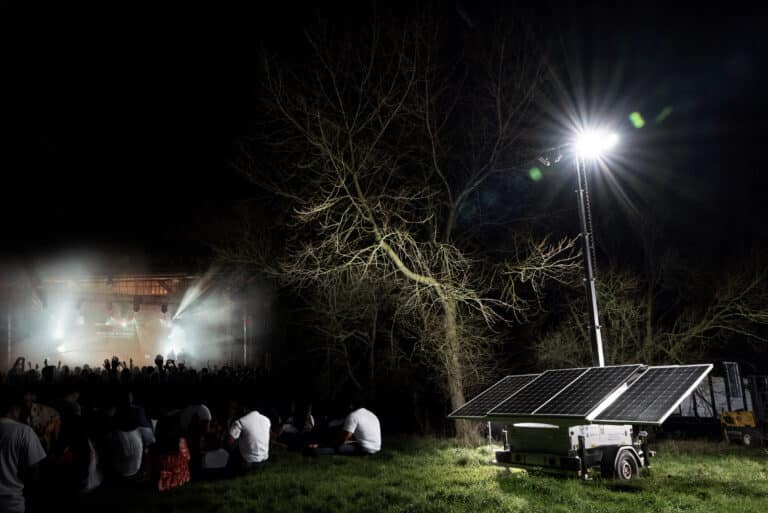
- Mobile charging power that can move between work fronts
- A practical way to trial electric plant or fleet vehicles before investing in permanent infrastructure
The objective is not necessarily to remove the grid from every application. It is to select the most appropriate combination of grid, solar generation, battery storage and backup power for the site’s actual operating profile.
Why Diesel-Powered EV Charging Can Be Inefficient
A diesel generator can provide dependable power independently of the grid. It is familiar, readily available and relatively easy to deploy. However, using a conventional generator as the sole charging source can introduce significant environmental and operational inefficiencies.
Generators are often selected to meet the highest anticipated load, even when that peak occurs only briefly. During the remainder of the day, the generator may run at a low load or idle while producing far more mechanical capacity than the site is using. This wastes fuel and increases engine hours without delivering a proportional amount of useful electricity.
Charging an electric vehicle from a diesel generator also involves energy losses at several stages. Chemical energy in the fuel is converted into mechanical energy, then electricity, passed through the charger and stored in the vehicle battery. Energy is lost as heat at each stage.
The impacts extend beyond carbon dioxide. Diesel operation can also create:
- Nitrogen oxides (NOx) and particulate matter (PM)
- Local air-quality impacts
- Noise pollution
- Fuel storage and transportation requirements
- Spill risk
- Refuelling labour
- Increased servicing and maintenance
- Unplanned downtime from prolonged low-load operation
- Exposure to fuel-price volatility
The environmental benefit of electrification is therefore influenced by the source used to charge the vehicle. A more accurate objective is to reduce the operational emissions associated with charging by maximising solar and stored battery energy and minimising generator runtime.
During solar and battery-only operation, charging can take place without direct engine exhaust emissions or generator noise. A backup source may still be required during sustained high demand, extended low-solar conditions or unusual operational events. The value of the hybrid system lies in using that backup efficiently rather than operating it continuously.
The Whole-Life Cost of Temporary Charging
The cost of charging should not be assessed using the price of the generator, BESS or charge point alone.
A whole-life comparison should include:
- Equipment hire or purchase
- Installation and commissioning
- Fuel consumption
- Fuel deliveries
- Refuelling labour
- Generator servicing and maintenance
- Transport and relocation
- Distribution equipment and cabling
- Grid connection assets
- Trenching and civil works
- Charger-management subscriptions
- Operational downtime
- Carbon measurement and reporting
- Residual value or the ability to redeploy the equipment
Battery-supported systems can reduce cost by lowering generator hours, avoiding unnecessary fuel use and making a smaller or more efficiently loaded generator possible. They may also remove or delay permanent infrastructure costs where the charging requirement is temporary.
Savings will vary by load profile, fuel price, system configuration, solar conditions and project duration. Claims should therefore be based on measured site data or a clearly defined baseline rather than a generic percentage.
How Solar Hybrid and Battery-Supported EV Charging Works
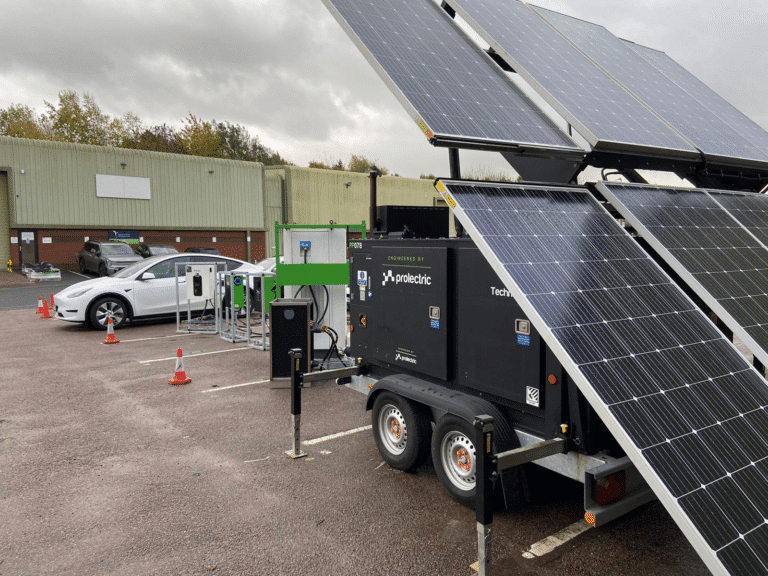
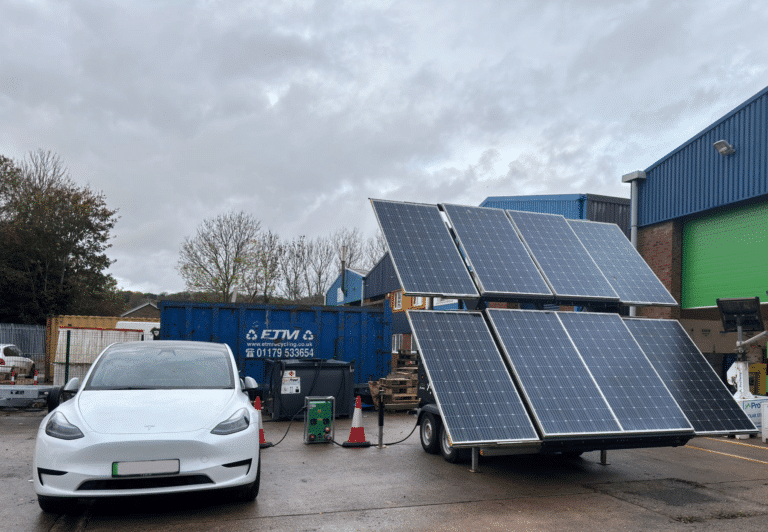
A temporary off-grid charging system generally combines several components:
- Solar photovoltaic panels generate electricity when conditions allow.
- The generated energy is stored in an onboard battery.
- An energy-management system controls how solar, battery and backup inputs are used.
- The battery and inverter supply electricity to the charge point and other connected site loads.
- A grid or generator input can replenish or supplement the battery when required.
Solar generation and charging demand should not be confused. Solar panels generate energy over time, while the battery and inverter determine how much power can be delivered at any one moment.
For example, a charger drawing 22 kW will require more instantaneous power than a 5.28 kW solar array can generate in real time. The difference must be supplied by the battery, grid input or backup generator. The solar array then contributes to replenishing the stored energy over the course of the day.
This is why system design must consider both:
- Energy, measured in kilowatt-hours, which indicates how much electricity must be delivered over the charging period.
- Power, measured in kilowatts or kilovolt-amperes, which indicates how quickly that energy can be supplied.
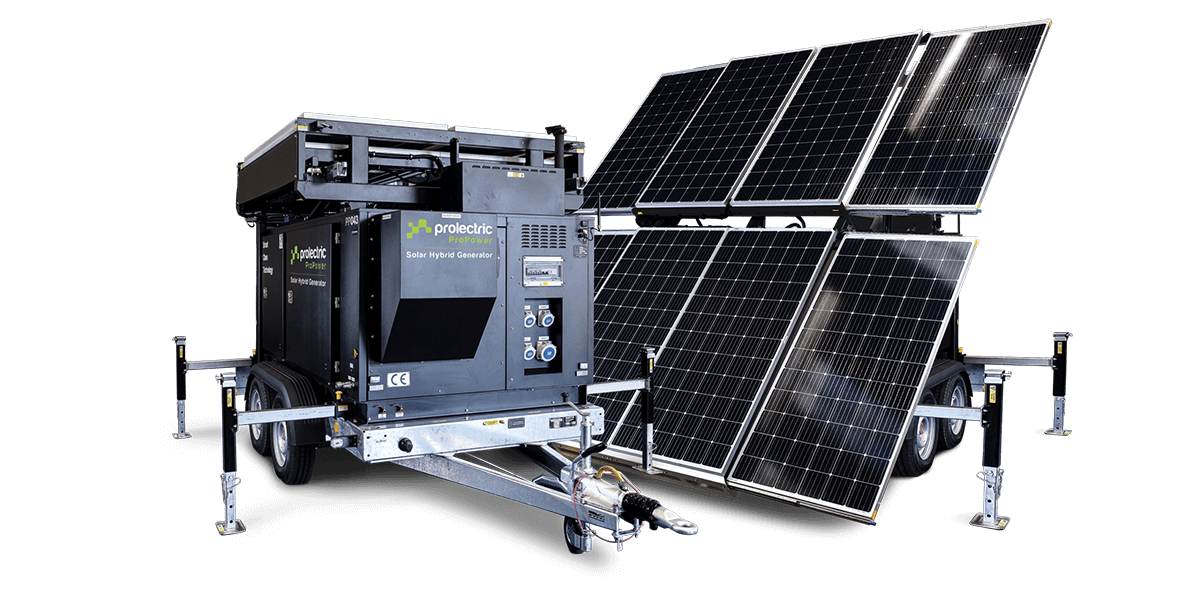
ProPower Solar Hybrid Generator
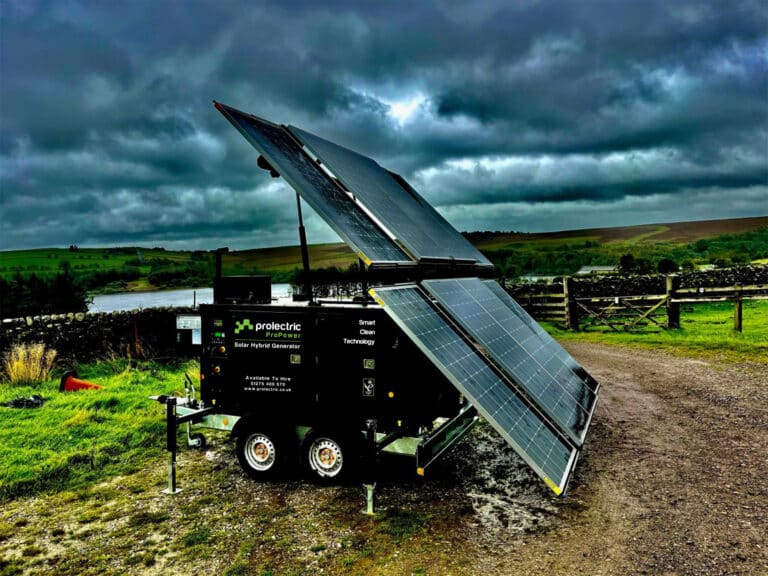
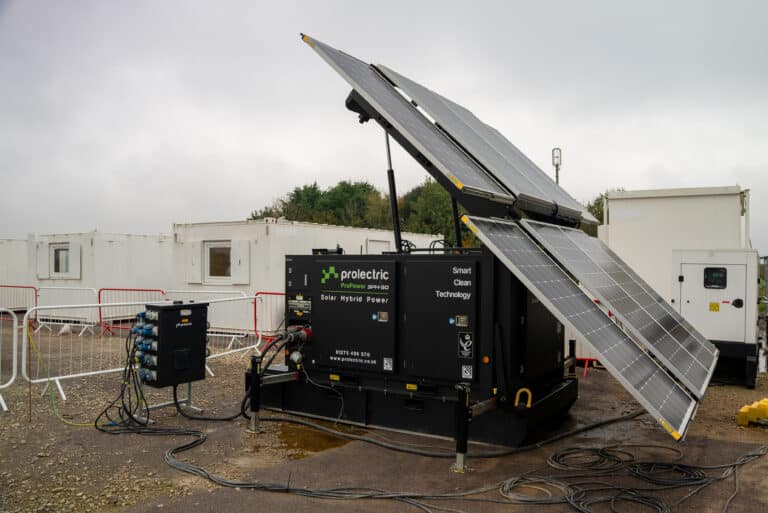
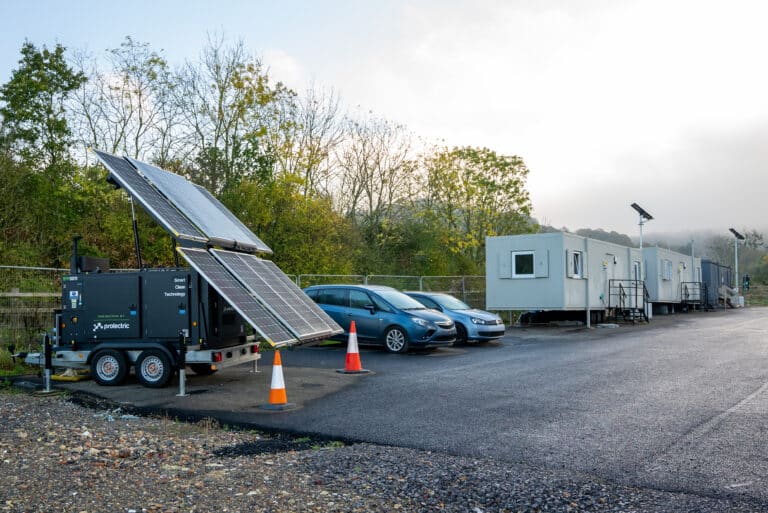
The ProPower Solar Hybrid Generator is designed for mobile, temporary and lower-demand charging applications.
It combines:
- A 35 kWh battery
- A 3.04 kW deployable solar array
- An integrated HVO-compatible backup generator
- Approximately 10 kVA battery-only output
- A generator configuration rated between approximately 17.5 and 22.5 kVA, depending on the model
- Trailer-mounted deployment
- Smart Remote monitoring and GPS tracking
The system prioritises solar generation and stored battery energy. The integrated engine starts when required by the battery state, load or configured reserve settings, rather than running continuously.
ProPower is most suitable for lower-power AC charging, electric vans, cars, smaller electric plant and mixed site loads. The correct charger rating must be established from the vehicle acceptance rate, charging window and other equipment being powered at the same time.
ProCharge Solar Battery Energy Storage System
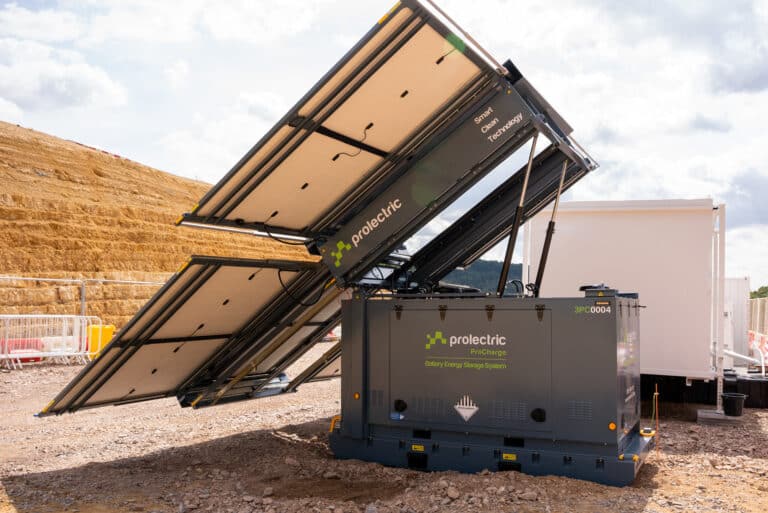
ProCharge is a higher-capacity, three-phase BESS intended for larger charging requirements and high-demand site applications.
It combines:
- 120 kWh of battery storage
- A 5.28 kW deployable solar array
- A 45 kVA inverter
- Three-phase output
- External generator or grid input
- Support for generators of up to 100 kVA, subject to the final system design
- Remote monitoring and GPS tracking
- Skid-mounted deployment
Unlike ProPower, ProCharge does not include an integrated generator. It can operate from stored battery energy, receive energy from its solar array and connect to an external grid or generator source when replenishment or additional support is required.
The battery acts as an energy buffer. It can satisfy variable or short-duration loads without requiring the external generator to track every rise and fall in demand. When a generator is needed, it can operate at a more effective load to recharge the battery and then shut down.
This makes ProCharge suitable for multiple charge points, three-phase applications and sites where charging must operate alongside welfare, cabin or other temporary electrical loads.
The Charger and Vehicle May Be the Limiting Factor
The capacity of the power system does not automatically determine the charging rate received by the vehicle.
The actual rate depends on:
- The available power-system output
- The charger rating
- Whether the supply is single-phase or three-phase
- Whether AC or DC charging is used
- The vehicle’s onboard AC charger
- The vehicle’s DC charging capability
- Battery temperature and state of charge
- The vehicle charging curve
- Other simultaneous site loads
- Load-management settings
Connecting a vehicle to a 22 kW AC charger does not guarantee that the vehicle will accept 22 kW. Many UK cars are limited to 7 kW or 11 kW AC through their onboard charger. Larger commercial vehicles and electric plant may require longer charging windows or a compatible DC charger.
Prolectric’s current temporary charger configuration offers variable AC charging output up to 22 kW, with the delivered output determined by the supply and vehicle. Higher-power DC charging requirements would need a separate, site-specific charging and power design.
The same principle applies to the number of vehicles connected. Four charge points do not necessarily mean four vehicles can charge at full power simultaneously. Sequential charging, dynamic load allocation and priority settings may be required to keep the combined load within the available capacity.
Power-System and Charge point Management
Prolectric’s Smart Remote Portal provides visibility of the power system, including battery status, solar generation, connected load, generator activity, fuel performance and carbon savings. This allows operators to identify abnormal demand, monitor performance and manage equipment across multiple locations.
Charge point-level functions are managed separately. A compatible charge point-management platform can provide:
- User access control
- Tariff and payment management
- Charge point availability
- Charging-session information
- Load balancing
- Energy allocation
- Usage and billing reports
Keeping these functions separate is important. Our Smart Remote Portal monitors and manages the power asset, while the charge point-management platform manages the charging users and sessions.
In Part 3, we examine where these systems have been used, what the measured results show and how temporary charging should be specified before equipment reaches the site.

Daniel Tipper
Business Development Manager
Share


FAQs
Solar panels generate electricity when conditions allow and store it in a battery. An energy-management system then controls how solar, stored battery energy and any grid or generator input are used.
The battery and inverter supply electricity to the charger and other connected site loads. A grid connection or generator can replenish or supplement the battery when demand exceeds the available solar and stored energy.
Kilowatt-hours, or kWh, measure energy. This indicates how much electricity must be delivered to the vehicles and other loads over a period of time.
Kilowatts and kilovolt-amperes measure power. These indicate how quickly the system can deliver energy and how much simultaneous demand it can support.
A system must be sized for both the total daily energy requirement and the highest realistic power demand.
A generator may be sized for the highest expected load but spend much of its operating time at a lower load. This can waste fuel and increase engine hours without producing a proportional amount of useful electricity.
Additional energy is also lost as fuel is converted into mechanical power, then electricity, passed through the charger and stored in the vehicle battery. Diesel operation can also introduce noise, NOx, particulate matter, fuel transport, spill risk, servicing and refuelling requirements.
Solar generation is lower during winter, so a resilient system should not assume that solar alone will supply every charging session.
Reliable winter performance depends on the combination of solar generation, stored battery energy, intelligent controls and a suitable backup or recharge source. A Heathrow winter deployment recorded 490 hours without diesel from 522 operating hours between December 2025 and February 2026.
Not necessarily. The delivered charging rate can be limited by the vehicle’s onboard charger, the charger itself, the available power supply, battery temperature, state of charge and other connected site loads.
Many UK cars accept a maximum of 7 kW or 11 kW AC, even when connected to a 22 kW AC charger. Load management may also reduce or stagger charging rates when several vehicles are connected.
ProPower is generally better suited to mobile, lower-power charging requirements, such as cars, vans, smaller electric plant and mixed temporary site loads. It combines a 35 kWh battery, 3.04 kW solar array and integrated backup generator.
ProCharge is better suited to larger or three-phase charging requirements. It provides 120 kWh of battery storage, a 5.28 kW solar array and a 45 kVA inverter, with the option to connect to an external generator or grid supply.
The final system should be selected according to the number and type of vehicles, charger ratings, available charging windows and other loads drawing power at the same time.